Uncategorized
Night Vision Explained: IR vs Starlight vs Full-Color Security Cameras
Jun
Every security camera spec sheet lists “night vision” — and almost none of them explain what kind. That’s a problem because three very different technologies are sold under the same label, and the one you end up with determines whether your night footage is genuinely useful or just barely good enough to know something moved.
This post walks through the three night-vision technologies you’ll actually find in modern security cameras — infrared, starlight, and full-color — what each one produces, what it costs, and which one is the right call for the spot you’re trying to cover.
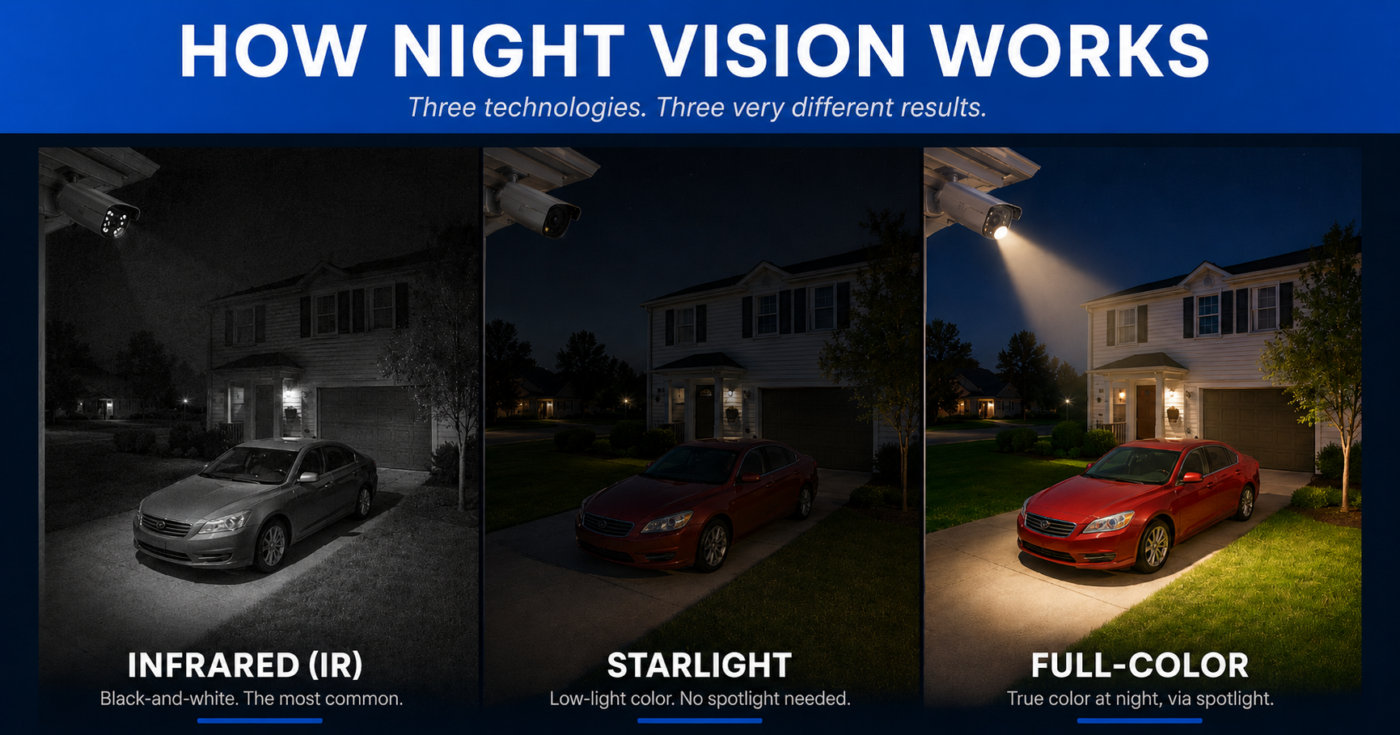
The three technologies at a glance
Most common
Infrared (IR)
Records in black and white using invisible IR light. Most affordable, most cameras have it, lowest fidelity.
Mid-tier
Starlight
Records in muted color using just available ambient light (moon, streetlamp, porch light). No spotlight required.
Premium
Full-Color Night Vision
Records in full vivid color at night using an integrated white-light spotlight that turns on automatically.
Every one of these has a legitimate use case. The mistake most buyers make isn’t picking the wrong one — it’s not realizing they’re different in the first place.
Infrared (IR) — the default
Infrared is the technology nearly every consumer camera has been using for over a decade. The camera surrounds its lens with a ring of IR LEDs that emit light at a wavelength human eyes can’t see. The camera’s image sensor can see it, so the camera essentially illuminates the scene with invisible light and records what bounces back.
The output is always black and white. There’s no color information in IR — the camera is reading light intensity, not wavelength, the same way an old security camera or a night-mode smartphone photo strips color.
What IR is good at
- Cost. IR is the cheapest of the three by a wide margin. Even budget cameras come with usable IR night vision.
- Range. Modern IR LEDs can illuminate scenes 80–130 feet away — much further than a spotlight comfortably reaches.
- Discretion. Because the light is invisible, an intruder won’t notice the camera “lighting up” when they trigger it. This matters for covert monitoring or properties where you don’t want a visible deterrent.
- Reliability. No moving parts, no spotlight bulb to burn out, no day/night sensor switching.
Where IR falls short
- No color. If the question you’re trying to answer after the fact is “what color was the car?” or “what was the suspect wearing?” — IR can’t tell you.
- Reflective surfaces wash out. Glass, polished metal, license plates, and bright signs throw the IR light right back at the camera, often blowing out detail.
- Glow eyes. Eyes (human and animal) reflect IR strongly and appear as bright white circles — distinctive but unnatural.
Starlight — the quiet upgrade
Starlight isn’t a separate light source. It’s a more sensitive image sensor — one that can pull a usable color image from very little ambient light. A starlight-rated camera doesn’t need its own spotlight or IR LEDs to function in low light; it just needs some light somewhere in the scene. The moon. A streetlight a block away. A neighbor’s porch light. A faint glow through curtains.
The result: muted, slightly desaturated color footage that still preserves the information a black-and-white IR image throws away. Red cars are clearly red. Green grass is clearly green. Faces have skin tones rather than reading as shadowed grey shapes.
What starlight is good at
- Color retention without a spotlight. You get color identification at night without lighting up the scene.
- Subtle deployment. Like IR, starlight doesn’t announce its presence. No spotlight cone, no IR glow.
- Low light, not no light. In a neighborhood with even moderate ambient light (suburban streets, lit driveways, urban areas), starlight produces footage that looks closer to dusk than midnight.
Where starlight falls short
- Total darkness. Starlight needs some light. In a pitch-black rural setting with no nearby streetlamps, a starlight camera struggles where IR is fine.
- Cost. Starlight-capable sensors are more expensive than basic sensors with IR.
- Color fidelity isn’t perfect. Footage is dimmer and less saturated than daylight. It’s a clear upgrade over IR for identification purposes, but it’s not photographic quality.
Full-color night vision — when you want daytime quality at night
Full-color night vision pairs a sensitive sensor with an active visible-light source — usually a built-in white-light LED spotlight that triggers automatically when motion is detected, or runs continuously if you choose. The camera doesn’t have to pull color from ambient light because the camera is providing the light itself.
The output is the brightest, most accurate color rendering of the three. License plates read cleanly. Skin tones look natural. Vehicles’ makes and models are clearly identifiable. It’s effectively a daytime image captured at night.
What full-color is good at
- Maximum identification clarity. If you ever need to give law enforcement footage they can actually act on, full-color is the technology that delivers it.
- Active deterrence. The spotlight isn’t just for the camera — it’s a visible signal to anyone in the camera’s view that they’ve been seen. Many intruders abandon the attempt at this stage.
- Total darkness performance. Because the camera provides its own light, it works the same in a pitch-black backyard as it does on a streetlit driveway.
Where full-color falls short
- Cost. Most expensive of the three.
- It’s not discreet. The spotlight makes it obvious the camera is there. Sometimes that’s the goal; sometimes it isn’t.
- Light pollution. A spotlight visible from a neighbor’s window can become a complaint, especially if the camera triggers often.
- Spotlight range. Practical spotlight coverage is roughly 30–60 feet — shorter than IR’s 80–130-foot range. For long driveways or large yards, you may not light up the whole scene.
What about bi-spectrum and thermal?
There’s a fourth category worth mentioning: bi-spectrum cameras combine a regular optical sensor with a thermal sensor in the same housing. They use the optical sensor for day and conventional night vision, and the thermal sensor to detect heat signatures — a person against a cool wall, a vehicle’s engine block, an animal moving through brush.
Thermal isn’t about producing pretty pictures; it’s about detection in conditions where optical can’t see anything (fog, heavy rain, dense vegetation). It’s overkill for most homeowners but indispensable for perimeter security on warehouses, ranches, and high-value commercial properties. If you’re considering it, you probably already know you are.
How to choose
| Use Case | Recommended Night Vision |
|---|---|
| Front door / doorbell area | Full-color (porch light may already provide ambient illumination; deterrent value adds up) |
| Driveway with one nearby streetlight | Starlight (you have ambient light; want color identification of vehicles without a spotlight running all night) |
| Backyard / fenced yard with no ambient light | Full-color (need the spotlight to provide illumination); fallback option: IR if discretion matters |
| Long driveway (100+ feet) or large lot perimeter | IR (better range than spotlight); upgrade to full-color at the camera nearest the house |
| Discrete monitoring (you don’t want intruders knowing the camera is there) | IR or starlight (no visible light) |
| License plate capture at night | Full-color (color is the difference between “dark car” and “dark blue sedan, plate readable”) |
| Total darkness, no ambient light, deterrent not desired | IR — the only option that works without adding any light to the scene |
How to read a spec sheet for night vision
When you’re comparing cameras, the night-vision specs that actually matter (in order):
- What technology is it? “Night vision” alone tells you nothing. Look for “IR,” “starlight,” “color night vision,” or “full-color night vision” specifically. If the spec sheet just says “night vision,” assume it’s IR.
- Minimum lux rating. Lux is the unit of measure for light intensity. Lower is better. A camera rated 0.01 lux can see in much darker conditions than one rated 0.5 lux. 0 lux means the camera works in complete darkness — only true of IR and active-spotlight cameras.
- IR distance. Listed in feet or meters. Standard is 80–100 feet; long-range IR cameras hit 130–160 feet.
- Spotlight specs (if full-color). Lumens for brightness; triggering behavior (motion-only vs continuous).
- Day-to-night transition. A good camera transitions cleanly at dusk. A cheap one flickers or alternates between modes for several minutes around sunset. Hard to read on a spec sheet — check reviews.
If a spec sheet doesn’t specify which night-vision technology a camera uses, that’s a flag. Reputable manufacturers say it directly.
Compare GW Security cameras by night-vision technology
Every GW Security camera lists its night-vision technology, IR distance, lux rating, and spotlight specs in full — no mystery numbers, no marketing fog.
Not sure which technology fits your property?
Our Help Me Choose tool asks six quick questions about your property and recommends a complete pre-configured system with the right night-vision technology for each camera location. About 60 seconds. No email signup required.